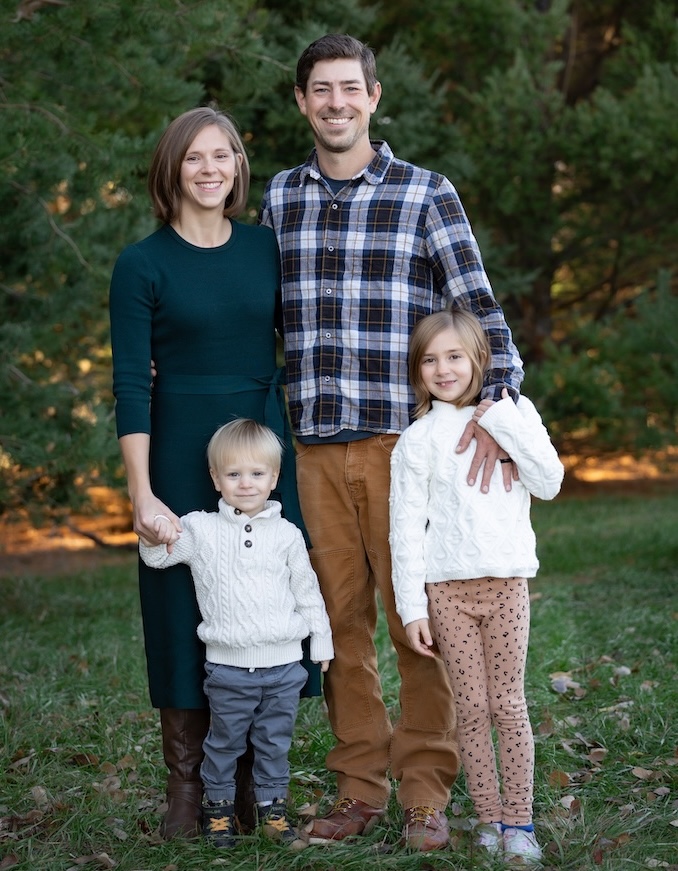
My name is Teddy Kimble. I’m a vegetable farmer in Pine Island, where I live with my wife and two young kids.
When I was four years old, my parents and I moved from Seattle to Pine Island for a new job and a new opportunity in the Rochester area. I started kindergarten a year later and continued at Pine Island through graduation.
One day after school in fourth grade, all the kids that wanted to be captains of their summer little league teams gathered in the head baseball coach’s sixth grade classroom. All of our names were on the board, as were the names of each registered second, third and fourth grader. We formed teams and like our later fantasy drafts, we picked rosters. The same was true for the fifth, six and seventh graders.
Throughout the summer, we captains were in charge of setting the lineups and calling our team in the event of weather delays. We all voluntarily scheduled our own practices and scrimmages.
There were some parents there, but the games were all during the day and none of them were required to attend. All of us kids just showed up, typically on our bikes, and coming from every which way and gravel road.
In addition to the kids, there were two teenagers hired to oversee operations. One would manage the bench and take book, the other would umpire and (for the little kids) pitch underhand.
I later worked for a few summers in this position. But towards the end (maybe around 2005), the parents were no longer happy. They demanded more involvement and they demanded more structure. Within a couple years, you could see the voluntary initiatives from kids decline, and their leadership opportunities stunted.
These experiences as a kid in small town Minnesota in the 90s greatly influenced who I am today, and what I want to see for my kids and grandkids in the future. I hope we can allow more wild play and freedom in the future.
After high school I chose to attend Macalester College in Saint Paul. I was raised with the expectation that college is the only path forward, but I would encourage my kids to also pursue a career in the trades and work towards owning a small business, if that’s something that interests them.
I graduated with a degree in physics and was a four-year starter and captain of the baseball team. I was awarded Macalester Male Athlete of the Year as senior. And while I was initially a bit embarassed by it, as I didn’t feel my stats justified it, I later learned that character plays an important role and I am proud of that award today.
I then attended the University of Wisconsin in Milwaukee to study design. I earned a Master of Architecture degree and focused my research on understanding and representing complex dynamical systems as “problems” and how these change during bifurcations. We tried to produce immanent qualitative beauty without ornamentation.
If my undergraduate education taught me how to learn in general, my graduate education taught me how to solve problems in general.
I graduated during the effects of the last great recession, and so the construction and architecture industries were still hurting and jobs were few and far between. I’ve always been a technically proficient person, and so I pivoted into software and landed a job at a small startup in Minneapolis.
I met my wife just days afterwards. We become engaged two years later, and then packed up our apartment and moved to Seattle to advance my career and change hers.
I never joined a company over 50 people, but the most demanding experience of my professional career was at a company that grew from a few dozen employees to nearly one thousand in just three years. By the end of that third year I was the only non-founding engineer reporting directly to the CTO, and I ran the only team without an engineering or product manager. I can manage high-level business concerns while also being the expert in the field.
In addition to learning a great deal about scaling businesses, I became a relative expert in managing and scaling high volume, distributed systems. There was enough traffic that if there was a one in a million chance of something going wrong, then I could be sure I'd be woken that night to fix it.
I don't shy from high pressure, technically difficult, or just plain hard jobs.
At the same time, my wife started her midwifery education and our daugher was born. We were busy. I chose to start a new job at a small remote-only software company, and when my wife finished her degree we moved back to Pine Island, where my parents still lived. Thank goodness for grandma!
I appreciated that last job very much, but it didn't provide the responsibility, autonomy or meaning that I desired. So I raised a small amount of seed funding from two former cofounders, and got to work building my own tech startup.
But my son was born shortly after — a homebirth just like his sister — and I realized that I never originally wanted to be a software engineer, and that I needed a job that could better connect me with my family and my community.
I decided then that I was going to become a vegetable farmer. We sold off our life savings and retirement, and bought 37 acres of bare corn and soy land. My tech startup become an "agtech" startup, which prototypes its first machine this summer.
Since I decided to become a farmer, I have learned how much the deck is stacked against small food producers.
The first challenge is legally acquiring buildable land. Sure, if you purchase 20 acres of farmland, you can put seeds in the ground. But you likely will not be able to construct a greenhouse, or a wash and pack station, or a coldroom. And you almost certainly won't be allowed to build a home.
And that may work for conventional corn and soy farmers, but folks that are growing produce, raising pastured eggs and meat, or making cheese from their own dairy will quickly tell you how necessary it is to live on your land.
If you are able to find and afford buildable farmland, you'll then be required to construct a petroleum-heavy home — small basic homes made from natural building materials are no longer legal under our building code.
And so although I do have a Master of Architecture degree, my basic home design was not good enough, and so we settled for now on a mobile home.
These two experiences ignited my drive to make agrarian rights legal again.
For the past four plus years, my wife and I have earned all of our income through our two small businesses, and I have seen firsthand how much friction our tax and regulatory system can make.
The system is designed mostly as "one sizes fits all", but that ultimately hurts small businesses the most. Larger corporations with teams of accountants and lawyers can more easily navigate the complex rules and regulations.
We believe our small businesses, like so many others, are important to our community. And so I have come to believe that we need to apply the lessons of scale to our lawmaking process.
And so I decided this year that I must run for state office to provide an alternate path forward for Minnesota, and to champion the merits of agrarianism, bottom-up thinking, and the original American Republicanism of Jefferson.
I know the partisan divide is strong. But I ask you now, regardless of where you stand, to support my candidacy on August 11th and honor our country's 250th birthday with renewed civic spirit.
Thank you for reading, and thank you for participating in democracy.
— Teddy